
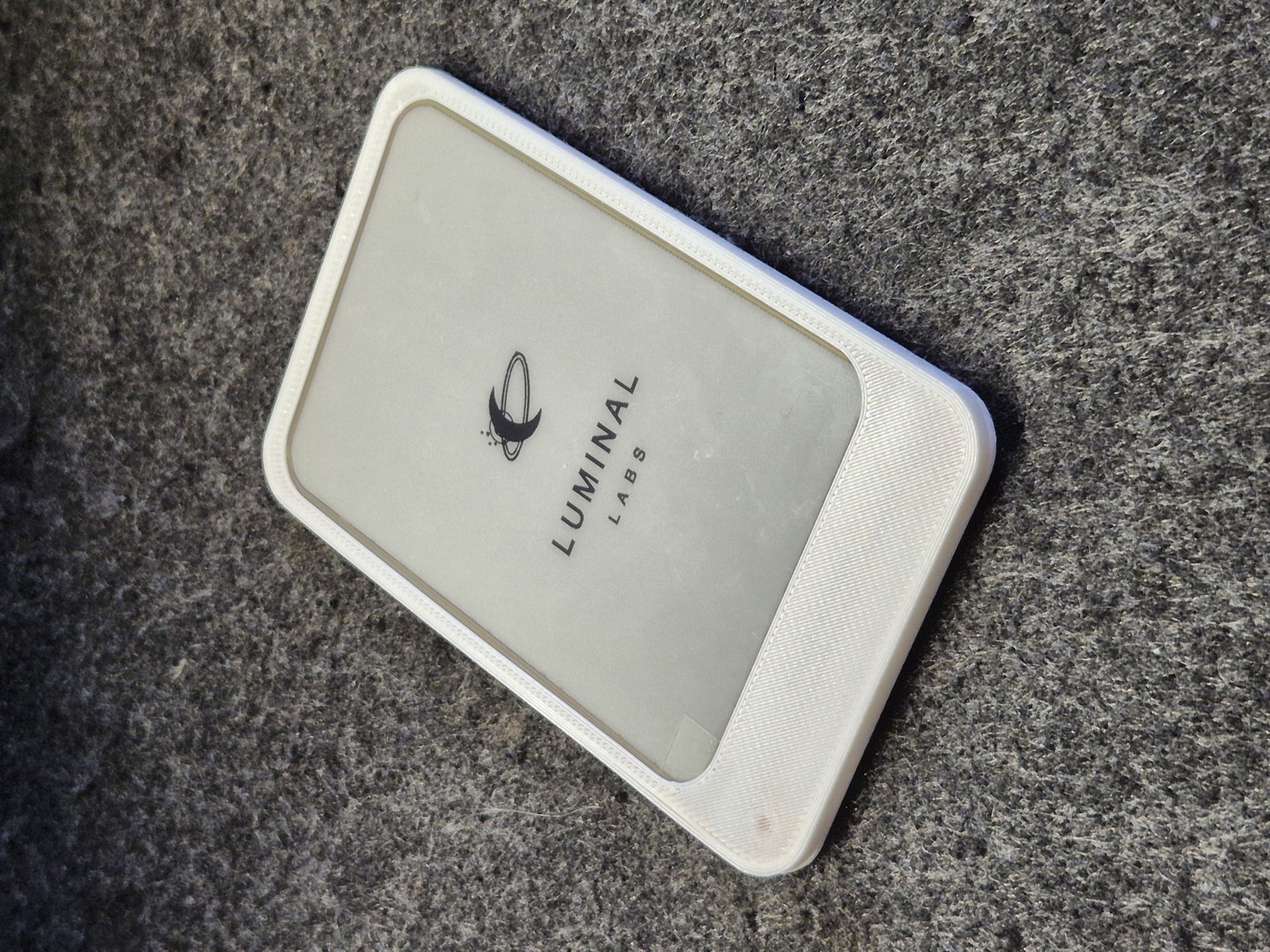
 prototype 01 · real, working today
Prototype 01 already works in our lab. The other pictures show the finished design we're building toward.
product 01 · the first instrument
Still
Working prototype · launching firstOne card. Real ink. Tap your phone to change the picture.
A photocard that keeps any picture you love in real ink, not light. It snaps to the back of your phone, changes with a tap, and then just stays, costing nothing to keep.
Ships from Sydney. Waitlist orders go out first.
what it feels like
A photograph that can quietly become another.
It rides on the back of your phone, so the picture comes with you. No glow, no cable, nothing to plug in. Stick it to a fridge or stand it somewhere when you would rather it stayed put.
Changing it feels like a small magic trick. Tap your phone to the card and the inks inside physically swim into the new picture, pass by pass. Someone far away can send a photo too: it lands on your phone, and one tap moves it into the ink.
It is magnetic and MagSafe compatible, so it travels the way a photocard rides in a wallet, and holds just as happily on a fridge or anything else a magnet will take.
Holding a picture costs nothing, so the battery is only ever spent on changing one. Fifteen minutes on a wireless charger buys about a year of normal use, and if the battery ever does run flat the picture stays exactly where it is.
Palm sized, under 5mm thin, in a soft matte shell. Built in Sydney.
First to launch, on Kickstarter. Join the list to be there at first light.
what it is
Seven things worth knowing.
Real ink, not a screen
Actual pigment particles, arranged like ink on paper. Nothing glows, nothing flickers, and it reads perfectly in daylight.
Full colour
Six pigments mix into a full colour picture, with the warm, settled look of a print rather than a backlit photo.
MagSafe compatible
It clicks straight onto any iPhone with MagSafe, and onto other phones with a magnetic case or ring. Pull it off and it will hold on a fridge, or anywhere else a magnet takes.
Change it with a tap
Exactly like tapping a card to pay, except what crosses over is a picture. Someone far away can send you one too: it lands on your phone, and one tap moves it into the ink.
A year on a charge
Fifteen minutes of wireless charging is a year of normal use, because power is only spent when the picture changes.
The picture never drops
Even with a flat battery the image stays exactly where it is. An empty battery looks the same as a full one.
Under 5mm thin
Palm sized and thinner than a pencil, so carrying it on the back of your phone costs you nothing in pocket or bag.
how it works
Watch the ink decide what you see.
Under the surface, every pixel is a tiny capsule holding six charged pigments. A single pulse lifts one of them to the top. Whatever reaches the surface is what your eye sees, and it stays there without power, like ink on paper.
the story at three depths
Your photo isn't on a screen, and holding it there costs nothing at all. It's just there, like a printed photograph that can quietly become a different one while you're not looking.
Every pixel is a microcapsule filled with charged pigment particles in six colours: white, black, red, yellow, green and blue. A single electrical pulse pushes them into position. Then they stay, for weeks and months at a time, without a single watt. The image isn't displayed; it's arranged, the way ink sits on paper.
Electrophoretic bistability. Charged pigments migrate through a fluid under a shaped electric field, then hold their position. No refresh, no standby power: once the field stops, the pigments simply have nowhere to go, so the image just stays. We'll share more of the science as launch approaches.
the signal list
Be first in line for Still.
The launch date and the lowest early-bird price, straight from the lab. One or two letters a month.